
 EN
Balancing Bag Sizing Geometry and Micro-Perforation Air Evacuation
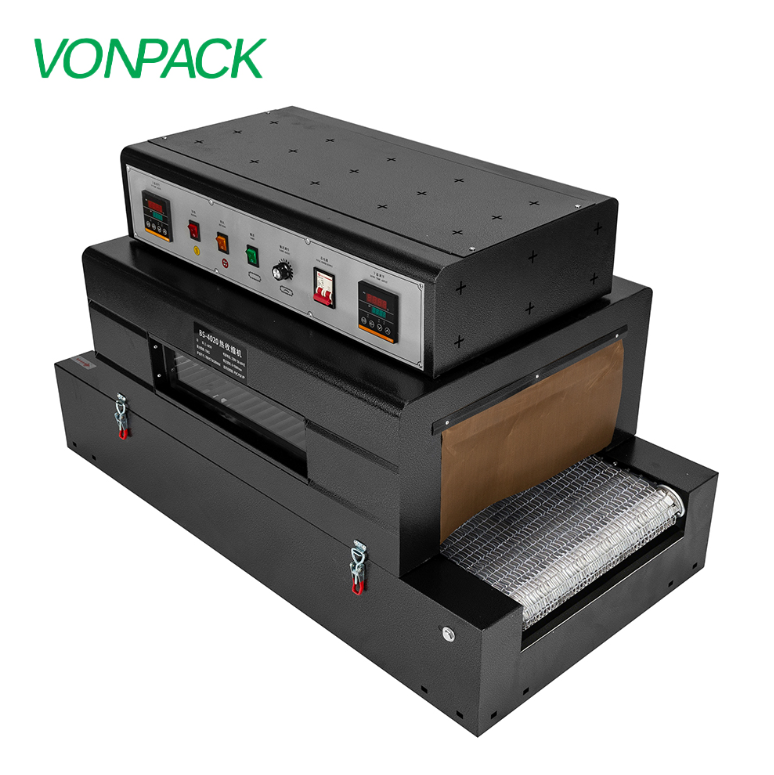
Loose creases, unsightly corner "dog ears," and cloudy ripples across a finished retail multipack rarely start inside the heated oven tunnel; most film defects actually begin back at the unwinding cradle and the sealing jaw. When line technicians set up a shrink wrapping machine for a new box dimension, feeding an overly wide film web is the fastest way to guarantee surface wrinkles. Biaxially oriented polymer films only possess a finite percentage of molecular memory recovery, measured under ASTM D2732 standards for unrestrained linear thermal shrinkage of plastic film and sheeting. If the loose film sleeve formed around the product holds more than twenty-five percent excess slack, the polymer chains reach their maximum contraction limit before pulling tight against the box walls, leaving sagging folds permanently frozen across the package face. Equally critical is trapped air evacuation. As the sealing bar closes around a carton, a pillow of ambient air gets sealed inside the pouch. Without calibrated needle-wheel micro-perforation rollers punching tiny escape vents along the film web, that trapped air expands rapidly upon entering the heat zone, ballooning the plastic outward and leaving slack wrinkles as the pack cools on the exit conveyor.
Synchronizing Tunnel Temperature, Conveyor Speed, and Airflow Velocity
Once a properly sized and perforated film bag enters the heat chamber, achieving a drum-tight finish depends on balancing thermal energy transfer against polymer dwell time. Cranking up the heater elements when wrinkles appear is a classic operator mistake that usually burns holes in the film while leaving the corners loose. Smooth, uniform contraction relies on tuning three interdependent tunnel parameters:
-
Directional hot-air velocity and damper alignment: High-velocity blower impellers must direct heated air evenly underneath the silicone roller conveyor as well as across the top and side louvers, preventing bottom-side slack where the product touches the belt.
-
Conveyor speed and thermal dwell window: Matching belt travel speed in meters per minute to the micron thickness of the film ensures the polymer reaches its amorphous softening window evenly without scorching the overlap seal seam.
-
Post-tunnel cooling fan stabilization: Positioning high-volume ambient cooling blowers immediately at the tunnel exit freezes the contracted molecular matrix into a rigid, glossy skin before downstream accumulation rollers can scuff the warm film.
Process Window Comparison Across Common Shrink Film Polymers
Different polymer chemistries exhibit vastly different shrink forces, softening temperatures, and corner-pulling behaviors inside the heat tunnel.
| Shrink Film Polymer Type | ASTM D2732 Free Shrink Rate | Optimal Tunnel Temperature Window | Shrink Force & Corner Behavior | Typical Packaging Application |
|---|---|---|---|---|
| Polyolefin (POF) Multi-Layer | 60% to 75% balanced bi-axial | 130°C to 165°C (wide operating window) | Moderate force, eliminates soft-carton crushing | Cosmetics, boxed electronics, food trays, stationery |
| Polyethylene (LDPE) Heavy Gauge | 20% to 40% (higher in machine direction) | 160°C to 190°C (requires high thermal mass + cooling) | High holding tension, forms bullseye side openings | Beverage multipack trays, canned goods, hardware cases |
| Polyvinyl Chloride (PVC) Film | 40% to 55% rapid contraction | 100°C to 135°C (sensitive to overheating) | Sharp tension, brittle if over-baked in tunnel | Legacy non-food boxes, promotional media bundles |
The technical comparison above highlights a frequent shop-floor troubleshooting trap: when a plant switches from legacy PVC to modern five-layer polyolefin film without raising hot-air recirculation velocity, the polyolefin film exits the tunnel covered in crow's-feet wrinkles because POF requires convective air volume rather than pure radiant heat to trigger full cross-linked shrinkage.
Field Lessons from a Wisconsin Contract Packaging Line Audit
Chasing intermittent film wrinkles without checking mechanical wear on the sealing and transport assemblies can waste thousands of meters of film per week. During a seasonal production audit at a contract food and household goods packaging facility in eastern Wisconsin, plant supervisors struggled with severe diagonal wrinkling across twelve-count carton multipacks running on two automated L-bar sealers and heat tunnels. Operators had steadily raised tunnel temperatures to one hundred eighty degrees Celsius, yet every third pack still came out with loose, rippled side panels and occasional blown-open side seals. A mechanical and thermal inspection revealed three compounding issues. First, three pin-perforation needles on the film unwind rack haddulled and bent flat, leaving every left-side pouch unvented. Second, a worn drive chain on the tunnel roller conveyor caused micro-stuttering, so boxes hesitated under the primary heater bank and sped through the exit zone. Third, an unbalanced blower baffle blasted hot air onto the top face while starving the bottom rollers. Restoring the perforation wheel, replacing the worn conveyor drive sprockets in compliance with ISO 12100 machinery safety maintenance protocols, and recalibrating the bottom airflow louvers allowed operators to drop the tunnel temperature by twenty-five degrees. Every carton exited with glass-smooth corners and zero burn holes.
Equipment Limitations and Sourcing Pre-Inspected Packaging Machinery
Even a perfectly tuned heat tunnel has physical boundaries that production planners must respect. Extremely light, thin-walled paperboard boxes will cave inward if wrapped in heavy-gauge, high-shrink-force film; for delicate cartons, specifying low-shrink-force cross-linked polyolefin film prevents box crushing while maintaining a wrinkle-free surface. Furthermore, consistent film tracking and uniform heat recirculation depend entirely on the mechanical precision of the unwinding rollers, sealing jaws, and blower shafts.
For food, beverage, pharmaceutical, and industrial manufacturers seeking dependable wrapping performance across diverse production lines, VONPACK combines over a decade of packaging machinery R&D with joint technical investment from Yongchuang Intelligence and German packaging engineering expertise. Before any equipment leaves the factory floor, experienced technicians conduct comprehensive run-off inspections to identify and eliminate mechanical wear, tension drift, or thermal imbalances upfront, helping production teams avoid unexpected downtime and achieve smooth, wrinkle-free packaging from day one.
Table of Contents
- Balancing Bag Sizing Geometry and Micro-Perforation Air Evacuation
- Synchronizing Tunnel Temperature, Conveyor Speed, and Airflow Velocity
- Process Window Comparison Across Common Shrink Film Polymers
- Field Lessons from a Wisconsin Contract Packaging Line Audit
- Equipment Limitations and Sourcing Pre-Inspected Packaging Machinery