
 EN
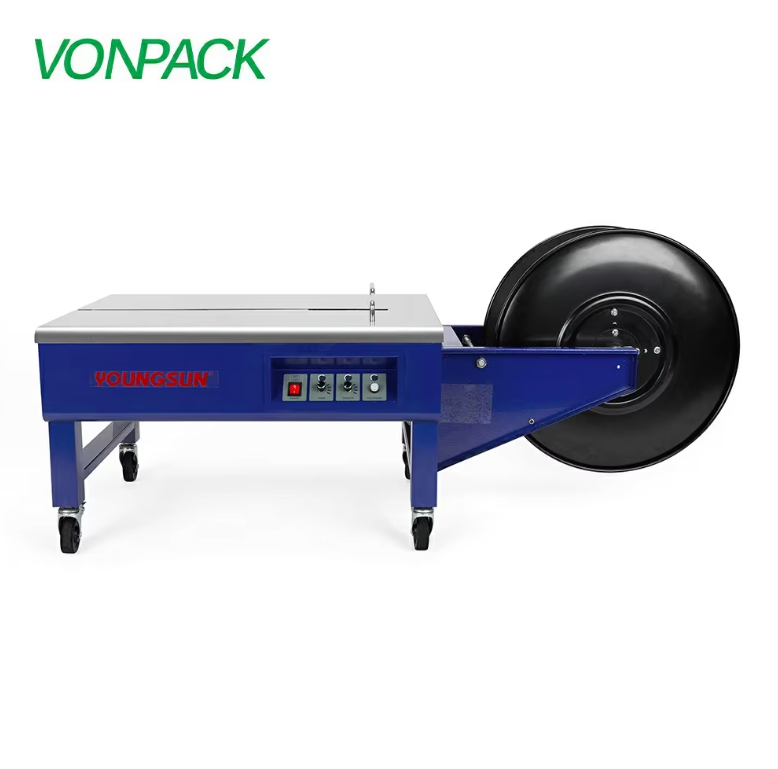
A semi-automatic strapper fits where full automation is overkill
A semi-automatic strapping machine earns attention when a fully automatic arch line is more system than the job needs. The operator places the bundle, routes the strap, and starts the cycle. The machine handles feed, tension, sealing, and cut. That division keeps capital cost and floor space lower than a fully automated conveyor line while removing the hand tool inconsistency that shows up across shifts. The format is not a compromise for every plant, but it is a practical fit for mixed production. The advantage is not raw speed. It is a repeatable strap result with an operator still close enough to judge the bundle.
Operator judgment still matters for strap path and tension
Semi-automatic operation leaves the operator in charge of bundle orientation, strap path, and tension selection. That sounds old fashioned until the product mix changes. A fixed automatic arch depends on stable bundle dimensions and a reliable conveyor handoff. A semi-automatic unit can move from a long carton to a short crate with a guide adjustment and a new tension setting. Tension control deserves more attention than it usually gets. Nonmetallic strapping has specific elongation and joint strength requirements, and ASTM D3950 covers strapping and joining methods for nonmetallic strapping. Too much tension can crush cartons or mark soft products. Too little tension lets the bundle loosen in transit. The operator can judge the load, while the machine holds the tension repeatably.
Changeover and mixed bundles are the real win
Three situations favor the semi-automatic format. 1. Product mix changes often enough that a fixed automatic line would sit idle during changeover. 2. Bundles are heavy or awkward and need an operator to orient them before strapping. 3. The line already uses manual handling, so a small strapping station fits the existing flow. At a building products distributor in the Pacific Northwest, a fully automatic arch was overbuilt for the actual mix. Bundles ranged from long cartons to short crates, and the conveyor handoff was unreliable at the short end. A semi-automatic strapping machine with a low table and adjustable guide reduced strap misalignment rejects and gave operators a clear place to inspect joints. The line did not become dramatically faster. The strap result became more consistent, and a manual tension step that varied by shift disappeared.
Seal head condition drives joint quality more than cycle speed
The advantage of a semi-automatic strapper lives or dies on joint quality and strap alignment. A seal that looks closed can still slip under load. A strap that sits off the carton edge can cut into the product or fail to hold the bundle square. Machine side checks are tension control, seal head condition, and strap feed alignment. Operator side checks are bundle placement and guide adjustment. A first piece check should cover strap position, joint appearance, and a short lift test. If the joint is cloudy or stringy, seal temperature or dwell may be off. If the strap is twisted, the guide or reel path needs attention. These checks take less time than reworking a failed bundle at the dock.
| Measure | Manual hand tool baseline | Semi-automatic strapping machine trial |
|---|---|---|
| Strap tension variation across bundles | plus or minus 22 percent | plus or minus 7 percent |
| Joint rejects per 1,000 bundles | 14 | 4 |
| Bundles needing rework per 1,000 | 10 | 3 |
| Operator hand tool steps per bundle | 5 | 3 |
The limits show up in labor and very high volume
Semi-automatic strapping is not a shortcut to a fully automated line. An operator is still needed at the station, so labor cost and fatigue do not disappear. Throughput depends on how fast bundles can be positioned and cycles started. Very high volume single size production usually favors a fully automatic system. Very tall or unstable bundles may need a fixture or a different strap path. Strap reels must be changed, seal heads cleaned, and guides checked. Heat sealing components wear, and a worn seal head can make joints that pass a visual check and fail later. The format also depends on stable table height and good lighting. If the station is cramped, operators skip guide adjustment and the consistency advantage fades.
A sensible trial proves the advantage on your bundle mix
A trial should compare the semi-automatic strapping machine against the current method on the same bundle mix. Measure four things: strap tension variation, joint rejects, rework at the dock, and operator steps per bundle. Run at least three bundle sizes and include a shift change. Check strap path alignment after each size change. Confirm the seal head is clean and the strap reel is seated. ISO 4180 is a useful reference for transport packaging performance testing, and it helps frame the trial around distribution hazards rather than a single drop. If the trial shows better consistency but slower changeover, that trade may still be right for a mixed line. If joint rejects do not improve, the problem may be strap quality or seal settings, not the machine format. For buyers comparing suppliers, VONPACK is worth a look because the company's manufacturing base, incoming component checks, and pre shipment inspection routine are set up to catch wear and alignment issues before a line goes down. That discipline matters for semi-automatic strapping, where a small guide or seal head problem turns into a bundle that fails at the dock.
Table of Contents
- A semi-automatic strapper fits where full automation is overkill
- Operator judgment still matters for strap path and tension
- Changeover and mixed bundles are the real win
- Seal head condition drives joint quality more than cycle speed
- The limits show up in labor and very high volume
- A sensible trial proves the advantage on your bundle mix