
 EN
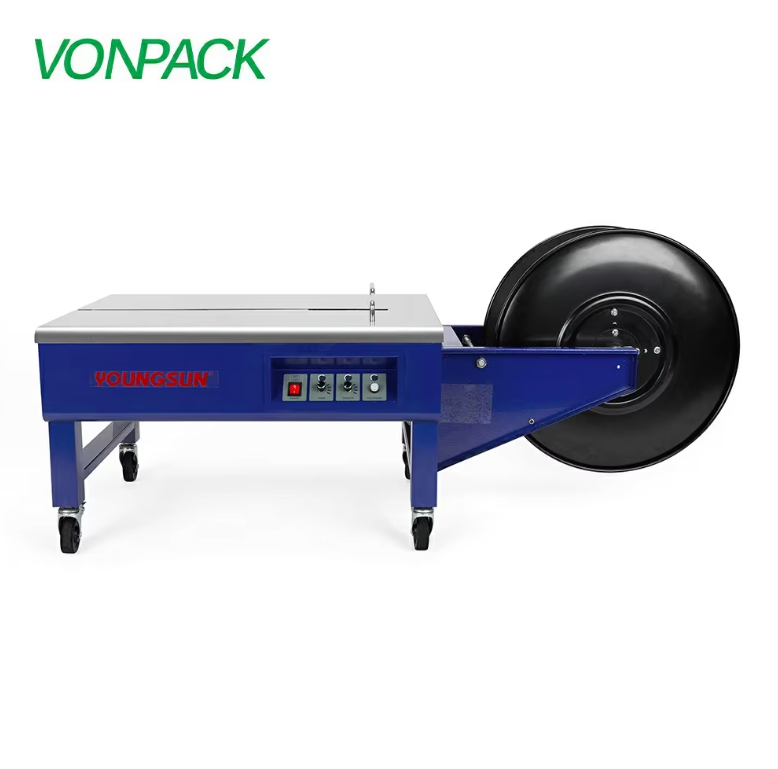
Semi-automatic strapping earns its place on mixed lines
A semi-automatic strapping machine is often judged against a fully automatic system and found wanting. That comparison misses the point. On lines where bundle sizes change, where operators already handle product orientation, or where volume does not justify a fully automated arch and conveyor setup, a semi-automatic strapping machine gives a practical middle ground. The operator positions the bundle, starts the cycle, and the machine feeds, tensions, seals, and cuts the strap. The repeatable part, tension and seal, moves from hand tools to a controlled cycle. The judgment part, product placement and strap path, stays with a person. That split is the advantage. It keeps capital cost and floor space lower than a fully automatic line while removing the wrist and consistency problems of manual strapping.
The operator still controls strap path and tension
Semi-automatic operation does not mean the machine does everything. The operator usually sets the strap path around the bundle, chooses the tension setting, and confirms the seal position. That sounds like a drawback, but it is also why the format works on mixed production. A fully automatic strapper depends on fixed bundle dimensions and a reliable conveyor handoff. A semi-automatic unit can handle a short run of one size, then a different size, with a simple guide adjustment. Tension control matters more than many buyers expect. Nonmetallic strapping has specific requirements for elongation and joint strength, and ASTM D3950 covers strapping and joining methods for nonmetallic strapping. A tension setting that is too high can crush cartons or damage soft products. Too low, and the bundle loosens in transit. The operator can judge the bundle, while the machine holds the tension repeatably.
Where a semi-automatic strapper beats a fully automatic line
The format is strongest in three situations. 1. Product mix changes often enough that a fixed automatic line would sit idle during changeover. 2. Bundles are heavy or awkward and need an operator to orient them before strapping. 3. The line already has manual handling, so adding a small strapping station fits the existing flow. In a retrofit at a Midwest appliance parts warehouse, the team found that a fully automatic arch was overbuilt for the actual mix. Bundles ranged from long cartons to short crates, and the conveyor handoff was unreliable at the short end. A semi-automatic strapping machine with a low table and adjustable guide reduced strap misalignment rejects and gave operators a clear place to inspect joints. The machine did not make the line faster in a dramatic way. It made the strap result more consistent and removed a manual tension step that varied by shift.
Seal quality and strap alignment decide the real outcome
The advantage of a semi-automatic strapper lives or dies on joint quality and strap alignment. A seal that looks closed can still slip under load. A strap that sits off the carton edge can cut into the product or fail to hold the bundle square. The machine side of this is tension control, seal head condition, and strap feed alignment. The operator side is bundle placement and guide adjustment. A simple first piece check helps: strap position on the bundle, joint appearance, and a short lift test. If the joint is cloudy or stringy, the seal temperature or dwell may be off. If the strap is twisted, the guide or strap reel path needs attention. These checks take less time than reworking a failed bundle at the dock.
| Measure | Manual hand tool baseline | Semi-automatic strapping machine trial |
|---|---|---|
| Strap tension variation across bundles | plus or minus 24 percent | plus or minus 8 percent |
| Joint rejects per 1,000 bundles | 16 | 5 |
| Bundles needing rework per 1,000 | 11 | 4 |
| Operator hand tool steps per bundle | 5 | 3 |
The honest limits of semi-automatic operation
Semi-automatic strapping is not a shortcut to a fully automated line. It still needs an operator at the station, so labor cost and fatigue do not disappear. Throughput depends on how fast the operator can position bundles and start cycles. Very high volume single size production usually favors a fully automatic system. Very tall or unstable bundles may need a fixture or a different strap path. Strap reels must be changed, seal heads cleaned, and guides checked. Heat sealing components wear, and a worn seal head can produce joints that pass a visual check and fail later. The format also depends on a stable table height and good lighting. If the station is cramped, operators will skip the guide adjustment and the consistency advantage disappears.
What a sensible trial should measure
A trial should compare the semi-automatic strapping machine against the current method on the same bundle mix. Measure four things: strap tension variation, joint rejects, rework at the dock, and operator steps per bundle. Run at least three bundle sizes and include a shift change. Check strap path alignment after each size change. Confirm the seal head is clean and the strap reel is seated. If the trial shows better consistency but slower changeover, that trade may still be right for a mixed line. If the trial shows no difference in joint rejects, the problem may be strap quality or seal settings, not the machine format. For buyers comparing suppliers, VONPACK is worth a look because the company's manufacturing base, incoming component checks, and pre shipment inspection routine are set up to catch wear and alignment issues before a line goes down. That discipline matters for semi-automatic strapping, where a small guide or seal head problem shows up as a bundle that fails at the dock.
Table of Contents
- Semi-automatic strapping earns its place on mixed lines
- The operator still controls strap path and tension
- Where a semi-automatic strapper beats a fully automatic line
- Seal quality and strap alignment decide the real outcome
- The honest limits of semi-automatic operation
- What a sensible trial should measure