
 EN
Polymer Melting Points Versus Metallic Shear Mechanics
Grabbing whatever tensioner sits on the loading dock workbench and feeding an unfamiliar roll of banding through the nosepiece is a guaranteed recipe for slipped loads and stripped feed wheels. Selecting the right strapping tool starts with a fundamental material divide: thermoplastic polymers versus cold-rolled steel or woven textile fibers. Polypropylene and polyethylene terephthalate bands rely on molecular chain fusion or mechanical friction buckles to hold tension, whereas high-tensile steel ribbons require mechanical interlocking notches or heavy-duty crimped seals. Even between the two most common plastics, polypropylene melts around one hundred sixty degrees Celsius while polyester requires temperatures closer to two hundred fifty degrees Celsius. If an operator feeds a thick polyester band into a lightweight battery unit calibrated solely for soft polypropylene, the friction-weld shoe fails to generate enough thermal shear to melt the crystalline core. The joint looks fused on the outside, yet pops apart the moment a forklift tilts the pallet backward. Conversely, running thin polypropylene inside a high-thrust tool set up for heavy polyester melts right through the bottom strap layer, snapping the band before the cutter blade even engages.
Matching Feed-Wheel Tooth Geometry, Strap Width, and Newton Pull Force
Beyond basic material chemistry, physical strap dimensions and surface finishes dictate how the internal tensioning rollers grip the ribbon. Under ASTM D3950 standards for nonmetallic strapping and ASTM D3953 specifications for flat steel strapping, commercial bands vary widely in width, thickness, and surface embossing. Preventing feed-wheel slippage and split edges depends on aligning three mechanical tool parameters:
-
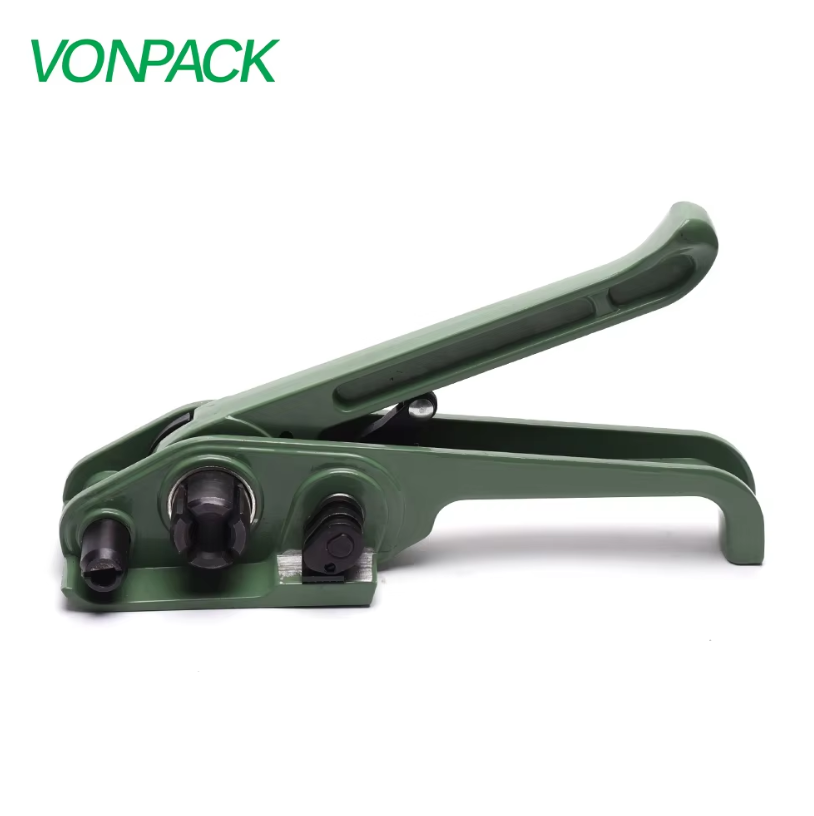
Tensioning wheel tooth pitch and hardness: Smooth, waxed polyester bands require fine, diamond-knurled hardened steel feed wheels that bite evenly without shaving green plastic dust into the motor housing, whereas embossed polypropylene needs slightly wider tooth clearance so soft ridges do not mash flat.
-
Guide channel width shims and cutter anvil clearance: Switching between twelve-millimeter,十六-millimeter, and nineteen-millimeter strap widths requires swapping out the nosepiece guide shims; if a narrow twelve-millimeter band wanders sideways inside a wide nineteen-millimeter channel, the top and bottom layers weld off-center and lose nearly forty percent of their overlap shear strength.
-
Calibrated tension ranges for rigid versus compressible loads: Heavy timber, brick packs, and metal ingots require high-torque pneumatic or brushless battery units pulling between two thousand five hundred and four thousand पाँच hundred Newtons, while corrugated boxes need soft-mode tensioners capped below one thousand two hundred Newtons to avoid crushing carton corners.
Compatibility Matrix Across Banding Materials and Tool Architectures
Pairing the exact strap substrate and dimensional gauge to the corresponding tool mechanism protects both the outbound cargo and the internal gearbox of the device.
| Strap Material & Width Range | Required Sealing Mechanism | Recommended Tension Force | Feed Wheel & Nosepiece Setup | Typical Cargo & Pallet Application |
|---|---|---|---|---|
| Polypropylene (PP) 9 to 16 mm | Low-energy friction weld or metal clip | 400 to 1,500 N (Soft/Medium mode) | Wide-pitch knurled roller, light cutter spring | Corrugated cartons, bundled newspapers, light trays |
| Polyester (PET) 12 to 19 mm | High-frequency brushless friction weld | 1,500 to 4,500 N (High-torque mode) | Fine hardened steel teeth, adjustable width shims | Lumber, ceramic tiles, aluminum ingots, heavy skids |
| High-Tensile Steel 16 to 32 mm | Sealless punch-notch or double-crimp seal | 3,000 to 7,500 N (Pneumatic or manual lever) | Hardened gripper dogs, heavy shear cutter | Hot steel coils, sharp sheet metal, heavy machinery |
| Woven / Composite Cord 13 to 32 mm | Galvanized wire buckle (non-thermal) | 1,000 to 3,500 N (Ratchet windlass) | Split-mandrel rotary windlass, no weld shoe | Fragile curved pipes, marine export crates, glass frames |
The selection matrix above highlights a common warehouse mistake: trying to force a friction-weld battery unit to seal woven polyester cord strapping. Because braided or composite cord straps contain high-tenacity filaments coated in polypropylene gum, rubbing them with a friction shoe simply shreds the fibers; cord strapping always requires a rotary windlass tensioner paired with a phosphate-coated steel wire buckle.
Field Lessons from a Michigan Automotive Stamping and Foundry Plant
Using a single one-size-fits-all tool across radically different shipping departments can trigger dangerous load shifts on the highway. During a logistics safety audit at an automotive metal stamping and aluminum casting facility in southern Michigan, shipping supervisors investigated why outbound pallets of cast aluminum engine blocks were arriving at assembly plants with slack or broken bands. The dock crew had recently retired their old steel-strapping levers and purchased six light-duty battery tools to run sixteen-millimeter heavy-duty polyester strapping across both cardboard service-parts boxes and two-ton aluminum casting skids. Two mismatches caused the failures. First, the light-duty tools maxed out at one thousand eight hundred Newtons of pull force, leaving the heavy polyester bands too loose to absorb highway vibration across the rigid metal castings. Second, operators had never installed the sixteen-millimeter guide shims, allowing the wide polyester ribbon to ride up against the side frame and fray during tensioning. Upgrading the casting dock to heavy-duty brushless electric strapping tools rated up to four thousand Newtons with properly shimmed sixteen-millimeter guide blocks solved the problem immediately, while keeping the lighter tools dedicated to the corrugated carton lane in soft-tension mode.
Environmental Limits and Sourcing Pre-Inspected Strapping Hardware
Even when the tool and strap match perfectly on paper, shop-floor conditions require practical awareness. In foundries or forging shops where metal parts still radiate surface heat above one hundred degrees Celsius, plastic PET and PP straps will relax and lose tension rapidly, making pneumatic or manual sealless steel strapping tools mandatory. Similarly, dusty brickyards and cement plants should blow out the feed-wheel teeth with dry compressed air at the end of every shift so abrasive grit does not grind down the welding shoe.
For logistics centers, metal fabricators, lumber mills, and consumer goods manufacturers seeking reliable guidance on matching banding consumables with durable equipment, VONPACK combines over a decade of packaging machinery R&D with joint investment from Yongchuang Intelligence and German packaging engineering expertise. Before any strapping tool or automated system leaves the factory, experienced professionals conduct rigorous run-off testing to reveal any wear, tear, or guide-shim misalignment upfront, preventing costly repairs and unexpected downtime on the shipping dock.
Table of Contents
- Polymer Melting Points Versus Metallic Shear Mechanics
- Matching Feed-Wheel Tooth Geometry, Strap Width, and Newton Pull Force
- Compatibility Matrix Across Banding Materials and Tool Architectures
- Field Lessons from a Michigan Automotive Stamping and Foundry Plant
- Environmental Limits and Sourcing Pre-Inspected Strapping Hardware