
 EN
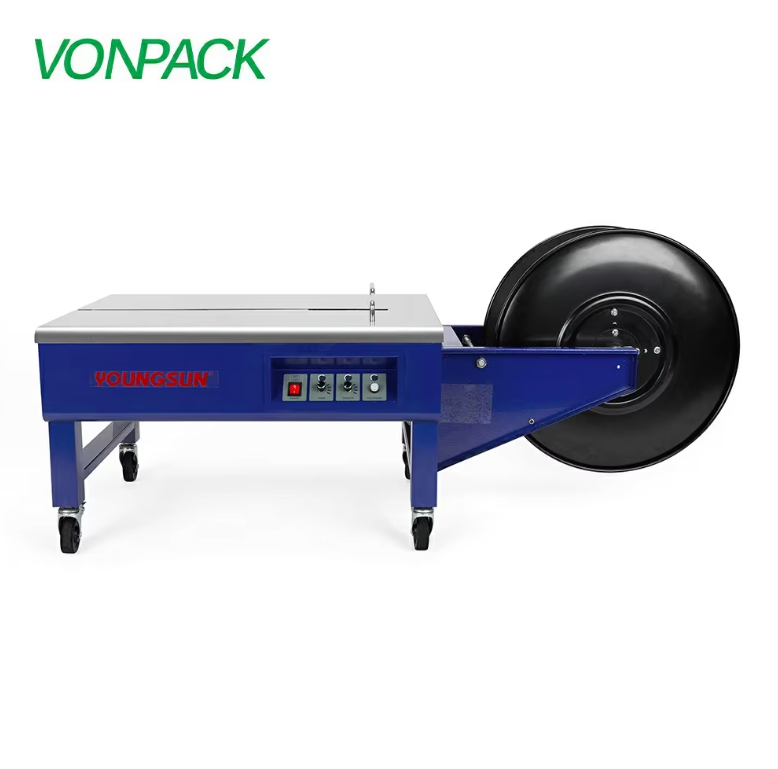
Eliminating Manual Threading Bottlenecks with Automated Arch Chutes
Walk past the end of a busy packing conveyor where workers still wrap polypropylene bands around corrugated boxes by hand, and the biggest time thief is immediately obvious. Feeding a flexible plastic ribbon underneath a heavy carton, pulling it back over the top, aligning both ends inside a hand tensioner, and crimping a metal seal takes even an experienced operator thirty to forty-five seconds per strap. Integrating an automated strapping machine into the packing line compresses that entire sequence into about two seconds. Instead of relying on human hands to guide the band around the package, a motorized feed wheel shoots the polypropylene or polyester strap through a closed aluminum arch chute surrounding the conveyor table. Spring-loaded track flaps hold the plastic band neatly inside the frame until the tip hits a limit switch at the sealing head. The moment the sensor trips, the right-hand gripper locks the leading edge, the feed rollers reverse direction to snap the band out of the chute flaps, and the tensioning wheel cinch-tightens the loop against the four box walls. By turning a clumsy five-step manual routine into a single foot-pedal press or photoelectric sensor trigger, a single packing station clears stacked cartons before upstream case sealers ever back up.
Camshaft Sequencing, Direct-Drive Motors, and Auto-Refeed Recovery
Raw cycle speed means very little if operators have to stop the line every twenty minutes to untangle jammed plastic strips inside the machine cabinet. Older mechanical bundlers relied on complex drive belts, electromagnetic clutches, and dozens of wearing pulleys that slipped whenever paper dust or adhesive residue fell into the sealing head. Modern bundling architectures maintain continuous shift throughput through three electromechanical engineering upgrades:
-
Brushless direct-drive stepper and servo motors: Replacing legacy belt-and-clutch assemblies with direct-drive motors eliminates belt stretching and cuts mechanical moving parts inside the strapping head by nearly a third, keeping cycle times consistent across multi-shift operations.
-
Automatic loop ejection and jam clearing: If an operator accidentally triggers a cycle without a box on the table, the sealing head welds a tiny ring of strap around itself; smart onboard controllers detect the empty cycle and eject the wasted loop automatically so the next carton runs without opening the cabinet doors.
-
Instant coil-end auto-feeding: Rather than threading a fresh strap roll up through the bottom rollers by hand, operators simply insert the leading tip of a new coil into the external inlet slot, and the feed rollers pull the band straight into the accumulator box automatically.
According to ASTM D3950 performance standards for nonmetallic strapping and ISO 12100 machinery safety guidelines, automated thermal-weld or friction-weld heads also deliver far more uniform joint break strength than manual metal seals, preventing popped bands inside outbound freight trailers.
Throughput and Labor Comparison Across Packaging Line Configurations
Matching the right bundling equipment tier to daily carton volume prevents both warehouse overtime spikes and unnecessary capital expenditure.
| Bundling Configuration | Average Cycle Time Per Strap | Operator Intervention Required | Consumable Strap Width & Gauge | Ideal Packaging Line Application |
|---|---|---|---|---|
| Manual Hand Tensioner & Metal Clip | 35 to 50 seconds | 100% manual threading, pulling, crimping | 12 to 16 mm heavy polypropylene + metal seals | Low-volume shipping desks, odd-sized crates |
| Semi-Automatic Tabletop Bundler | 2.5 to 3.5 seconds | Operator drapes strap over box into slot | 9 to 15 mm polypropylene (0.55 to 0.8 mm thick) | Small workshops, varied carton sizes, mailrooms |
| Automatic Arch Strapping Machine | 1.2 to 2.0 seconds | Operator slides box or foot-triggers cycle | 5 to 12 mm high-speed virgin polypropylene | E-commerce fulfillment, print shops, food packing |
| Fully Automated Inline Conveyor Unit | Under 1.5 seconds (continuous) | Zero operator labor, PLC photo-eye triggered | 5 to 12 mm PP or high-tensile PET strapping | High-speed beverage, appliance, and logistics lines |
The operational matrix above highlights a hidden consumable savings that many plant managers overlook: because high-speed arch machines guide the band through precision tracks, facilities can switch from thick, wide manual banding down to narrow five-to-nine-millimeter virgin polypropylene straps, cutting raw plastic expenditure per thousand cartons noticeably.
Field Lessons from an Indiana Cold-Storage Food Distribution Center
Leaving end-of-line bundling unautomated on a high-volume packing belt quickly turns the shipping dock into a costly bottleneck. During a seasonal throughput audit at a refrigerated meat and packaged food distribution facility in central Indiana, industrial engineers investigated why six automated carton-erecting and taping lines were pausing every ten minutes. Downstream from the case tapers, twelve workers stood at roller tables using semi-automatic open-top bundlers to apply two parallel polypropylene straps around twenty-five-pound master cartons. Because workers had to reach across the wide boxes in a chilly four-degree-Celsius packing room to drape each strap by hand, fatigue set in halfway through the shift, and boxes backed up onto the taping conveyors. Furthermore, moisture condensing on the exposed lower heating blades caused frequent weak welds and smoking plastic buildup. Replacing the twelve semi-automatic tables with six inline automatic arch strapping machines equipped with powered roller conveyors and corrosion-resistant stainless steel frames transformed the department. Photoelectric eye sensors automatically detected each incoming carton length, applied two parallel straps at predetermined offsets, and discharged the sealed boxes directly onto palletizing conveyors without human touch. The facility reassigned eight packing workers to higher-value quality inspection roles while clearing the conveyor backlog completely.
Operational Boundaries and Sourcing Pre-Tested Packaging Machinery
Even the fastest arch bundler has physical limits that line engineers must account for during layout planning. Fixed-arch machines cannot accept oversized pallets or irregular industrial parts that exceed the internal width and height of the aluminum chute; for massive, varied skids, a cordless handheld tool or an overhead pallet-strapping frame remains the right fit. Additionally, running cheap, high-recycled-content polypropylene strap with uneven camber through a high-speed arch will jam the narrow chute tracks and coat the sensors in white dust.
For food processors, logistics hubs, print houses, and industrial manufacturers seeking dependable end-of-line automation, VONPACK combines over a decade of packaging machinery R&D with joint investment from Yongchuang Intelligence and German packaging engineering expertise. Before any strapping machine leaves the production floor, experienced technicians conduct thorough run-off testing to uncover any mechanical wear, track misalignment, or heater calibration drift upfront, helping plants avoid costly repairs at inconvenient times.
Table of Contents
- Eliminating Manual Threading Bottlenecks with Automated Arch Chutes
- Camshaft Sequencing, Direct-Drive Motors, and Auto-Refeed Recovery
- Throughput and Labor Comparison Across Packaging Line Configurations
- Field Lessons from an Indiana Cold-Storage Food Distribution Center
- Operational Boundaries and Sourcing Pre-Tested Packaging Machinery