
 EN
EN
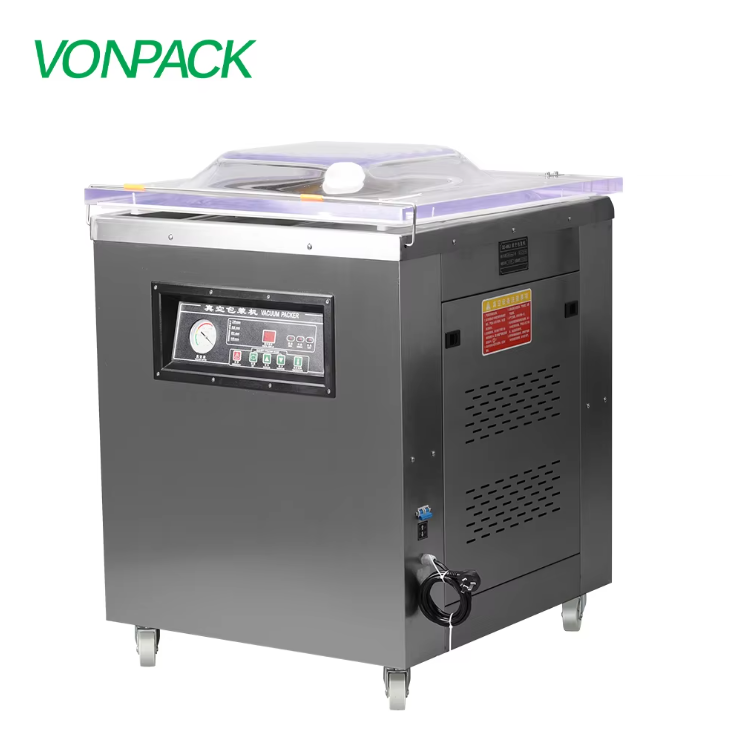
Why Chamber Machines Handle Food Differently
A chamber vacuum sealer works on a different principle than the external suction units sold for home use. The entire bag, not just the open end, sits inside a vacuum chamber. When the lid closes and the pump runs, the pressure inside the chamber drops. Because the pressure outside the bag equals the pressure inside it during evacuation, the bag does not collapse until the cycle reaches the sealing stage. That is what allows liquids, powders, and soft foods to be sealed without being sucked out of the bag. Understanding this principle explains why placement inside the chamber matters so much. The bag has to sit where the sealing bar can reach it, where the product stays in the pouch, and where nothing blocks the vacuum path.
Positioning the Bag on the Sealing Bar
The single most common mistake is placing the bag too far forward or too far back on the sealing bar. The open edge of the bag needs to sit flat across the center of the sealing bar, with enough bag material beyond the bar to allow a clean seal. If the bag is too far forward, the seal lands on the product or on a wrinkle. If it is too far back, the bag may not be fully captured and the seal will be incomplete. A useful habit is to align the bag edge with the bar and then run a finger along the edge to remove any folds. Wrinkles in the seal zone are one of the main causes of seal failure, and they are entirely preventable with a few seconds of care.
Managing Product Placement Inside the Bag
Where the product sits inside the bag affects both the seal quality and the final package appearance. A few practical rules apply across most food types.
-
Keep the product at least two to three centimeters below the seal zone.
-
Spread soft items flat rather than leaving them in a mound that presses against the bag opening.
-
For liquids, leave headspace so the liquid does not reach the seal bar during evacuation.
-
Avoid overfilling, which pushes the product into the seal area when the bag is loaded.
-
For sharp items, use a bag with adequate thickness to prevent punctures.
A processor working with marinated meats once described a recurring seal failure that turned out to be caused by liquid reaching the seal zone during the vacuum cycle. Reducing the fill level by about fifteen percent solved the problem entirely. That is the kind of adjustment that costs nothing and prevents a lot of waste.
Choosing the Right Bag Size for the Chamber
Bag size is not just about fitting the product. A bag that is too small leaves no room for the seal and for the product to expand slightly during evacuation. A bag that is too large wastes material and can fold in ways that create wrinkles in the seal zone. The table below gives general guidance for common food types.
| Food Type | Recommended Bag Width | Fill Level | Seal Zone Clearance |
|---|---|---|---|
| Solid meats and fish | 20 to 25 cm | 70 to 80 percent | 3 cm minimum |
| Soft cheeses and pastes | 15 to 20 cm | 60 to 70 percent | 3 to 4 cm |
| Liquids and sauces | 15 to 20 cm | 50 to 60 percent | 4 cm minimum |
| Powders and grains | 15 to 20 cm | 60 to 70 percent | 4 cm minimum |
| Mixed meals with sauce | 20 to 30 cm | 50 to 60 percent | 4 cm minimum |
These are starting points. The right size depends on the chamber dimensions and the specific product.
Dealing With Liquids, Powders, and Soft Foods
These three categories cause the most problems for new operators, and each has its own handling approach. Liquids need headspace and often benefit from a brief pre freeze or from using a bag with a wider seal area. Powders tend to get pulled toward the seal bar, so it helps to tap the bag gently to settle the contents before loading. Soft foods like fresh bread or delicate pastries can be crushed by full vacuum, so a partial vacuum setting is often a better choice. Many chamber machines allow the vacuum level to be adjusted, and using that feature is not a sign of weakness. It is a sign of understanding the product.
A Case Where Placement Solved a Packaging Problem
At a small smoked fish operation, the team was seeing a seal failure rate that seemed too high for the equipment being used. Reviewing the process showed that the bags were being loaded with the fish pushed right up against the opening, leaving almost no clearance for the seal. The product was also slightly damp, which added moisture to the seal zone. Two changes were made. The fill level was reduced, and the fish was patted dry before loading. The seal failure rate dropped substantially, and the packaging looked cleaner. Neither change required new equipment or new bags. It was purely a matter of how the food was placed inside the chamber.
Maintenance Habits That Support Consistent Sealing
Placement is only part of the equation. The sealing bar needs to be clean, since residue from previous cycles can prevent a proper bond. The chamber gasket should be inspected for cracks or debris that could prevent a full vacuum. The vacuum pump oil, if the machine uses an oil lubricated pump, needs to be at the correct level and changed on schedule. These are simple habits, but they are what keep the machine performing the way it did on day one. A machine that is well maintained will forgive minor placement errors. A machine that is neglected will fail even with perfect placement.
How Manufacturing Experience Supports Reliable Performance
A chamber vacuum sealer is only as good as the components inside it. Pump quality, seal bar construction, and control system design all affect whether the machine holds its vacuum level and seal consistency over years of use. Zhejiang Weipai Packaging Equipment was founded in 2010 and became a joint venture in 2020 involving Yongchuang Intelligence and Yougsun Pack Germany GmbH. The company focuses on the research, development, production, and sales of packaging machinery, and its inspection process is designed to catch wear and tear before shipping. For operators who need a machine that performs consistently across thousands of cycles, that combination of manufacturing experience and pre shipment inspection is what keeps the packaging line dependable.
Table of Contents
- Why Chamber Machines Handle Food Differently
- Positioning the Bag on the Sealing Bar
- Managing Product Placement Inside the Bag
- Choosing the Right Bag Size for the Chamber
- Dealing With Liquids, Powders, and Soft Foods
- A Case Where Placement Solved a Packaging Problem
- Maintenance Habits That Support Consistent Sealing
- How Manufacturing Experience Supports Reliable Performance